
designed for traffic jams
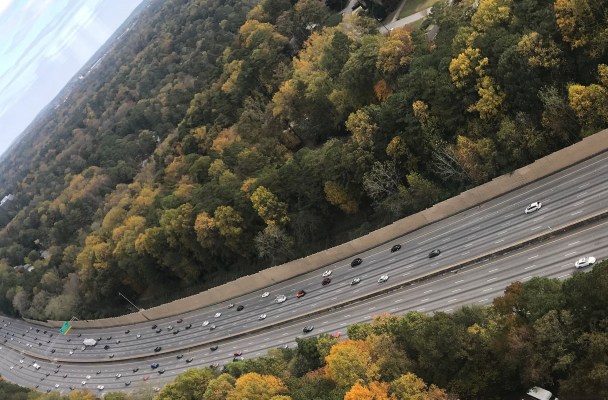
View from 27
In Shanghai, China there are many realistic options for getting around. In addition to driving a car, using ride-sharing services, riding a bus, renting a bike on almost every corner and returning it to any other, there is also a subway system with 16 lines covering over 650 kilometers of ground in and around the city. The Atlanta subway, called Marta, covers 48 miles (77 km) of rail track. Atlanta, Georgia, USA also has cars, ride sharing services and taxi’s but is severely limited on bicycles and pedestrians.
In general the streets in Atlanta are not pedestrian, bicycle, or scooter friendly. To some extent the city itself is pedestrian friendly, but the farther you move out from the center, the more dependent people are on cars. At the root of this is the lack of a useful subway system. One obvious fact of using a subway is that portions of your trip at the beginning, the end, and sometimes in the middle, are spent on foot, as a pedestrian. In a city where the subway hardly goes anywhere, and the places it does go are not overly pedestrian friendly upon arrival, there is a real deterrent to riding the subway. There are no readily available bicycles, and even if there were the roads are not bicycle friendly, with no separate lanes. There is a bus system but it does not run everywhere, especially in the suburbs. For example, there is no bus stop within several miles of my house in Johns Creek, Georgia, USA.
The Atlanta subway system includes three lines covering 77 kilometers of ground in roughly an X shape – north to south and east to west. The last stations were added in 2000, 18 years ago. There is talk of minor expansion, but it’s just that, talk. On my drive to work I pass the northern end of the subway just a few miles before arriving at the office. After sitting in traffic for 45 minutes, stopping at the subway to ride two stops is useless. If I did ride the subway, I still have to cross a major roadway where 10 or more lanes of cars are all juggling to get somewhere.
This walkway (pictured below) in the Lujiazui area of Pudong is a beautiful example of a functional pedestrian bridge.
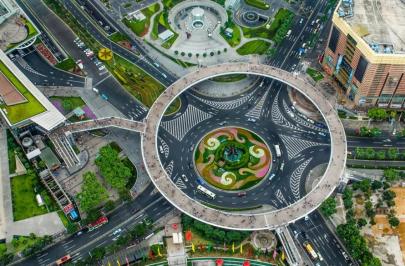
An often overlooked piece of mass transportation is the availability of pedestrian walkways. A pedestrian walkway above or under the road would be much more useful and used and could even display unique and interesting architecture. But there’s not even talk of anything like that in my city. In most Chinese cities, the roads all include a separate lane for bikes and motor scooters as well as pedestrians. They also have many elevated pedestrian walkways. But there are also many, many less elaborate pedestrian walkways and bridges.

One of many examples of beautiful and functional pedestrian bridges.
Last December I read the article below in the China Daily English language newspaper. Shanghai has approved spending US$43.28 billion on six new subway lines adding an estimated 286 kilometers of subway length to their already extensive system.
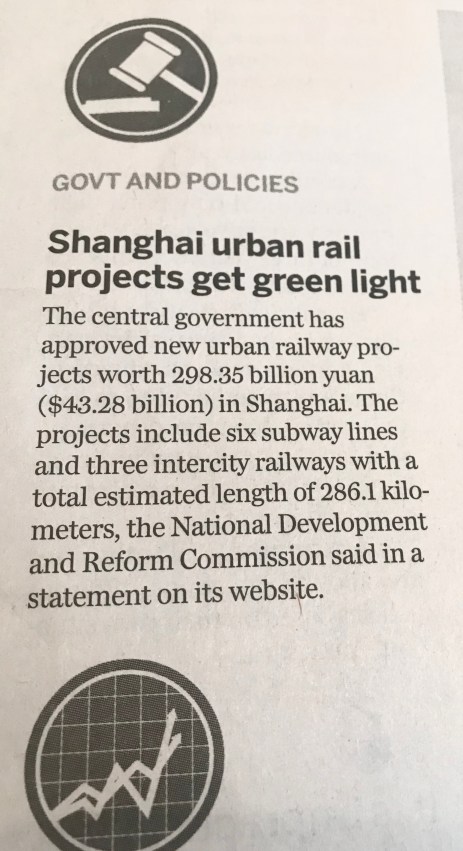
December 2018 article in the “China Daily” newspaper.
I thought how can we possibly compete with this? We don’t add one foot of track or one bus or one pedestrian walkway and Shanghai has funded a $43.28 billion plan to add six subway lines and three intercity railways with a total estimated length of 286.1 kilometers. Atlanta last added the North Springs and Sandy Springs stations in December of 2000, over 18 years ago. Not one foot (or meter) of track in 18 years. And in fact for a good part of that time the trains ran at a reduced schedule, sometimes causing wait times of 20 or 30 minutes for the next train. It is not just on miles of track that we fall behind, but also on number of cars and frequency of trains that we look more like a developing country.
Shanghai is admittedly a much larger city than Atlanta. But the lack of any activity in Atlanta is still amazing in comparison. Mass transportation isn’t just city infrastructure, it’s not just for people joyriding, it is the infrastructure for business and education and health care and art and theater. It takes workers to and from their place of work. Workers sitting in cars in traffic for several hours a day, even if every one of the cars were electric, is a massive waste of time and energy and money. Not to start a new topic, but building a stadium along a busy roadway rather than along a subway line, is nothing short of ignorant and represents a misappropriation of funds meant for the public good.
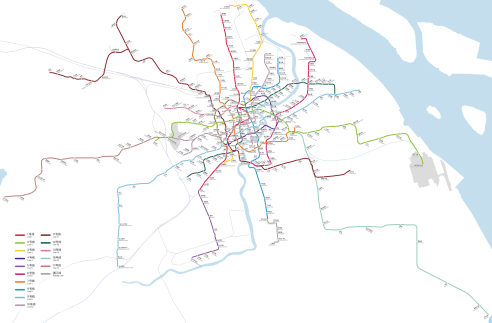
Shanghai Subway System
Some of you may say this can be done in China because the government funds it or because it is a communist country or any number of other reasons. Ok, but then why can’t we do it here? Why can’t we have these services for all the citizens of our city? So far I’ve been to 12 cities in China and every one of them outpaces Atlanta in terms of public transportation. Why are we making highways wider with lanes where people with more money can pay to bypass the traffic jam? Isn’t that a statement that the traffic jam will never end?
David
 david geiger
Leave a comment