
captured
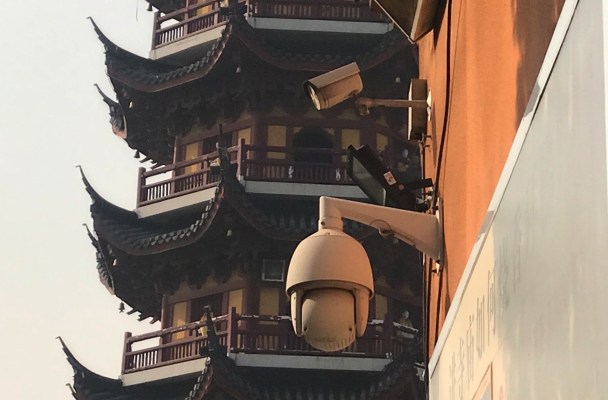
There are many things that can be captured on a camera – images, video, precise time, date, GPS location within 15 feet of the camera, familiar faces, current weather in location of the picture. Cameras capture our lives, but they can also imprison us. There is good reason for worry.
In the United States my experience has been that we expect to see cameras almost everywhere – certainly in 99% of all stores, government buildings, office buildings, shopping malls, and now the front doors of many houses. We have nearly as many cameras as China but the way we handle the data is vastly different (at least in relative peacetime).
Then, when some great crime is committed the police go talk to all the merchants, get court orders if needed, to get the relevant footage from any cameras that seem possible. Many times they find some clue to what happened at that moment in the past. In fact, most of the time there is no one watching the output of the camera, just a recording being saved in case it is needed later. It is likely no one would have been looking at any of the cameras at the time of the incident. Perhaps later on the day of the incident, or in the days soon after that, they will work on pulling all the video and possibly solve the crime.
The process in the United States is very slow, completely decentralized, with little ambition to do it any differently. It is relatively inexpensive for us, as each business or organization covers the cost of capturing and recording the video. And we do very little else.
One consequence of this is the lack of investment in video processing and analysis, facial recognition, database technologies, huge databases, massive processing. Another is our significant lack of awareness of the related opportunities and the dangers.
In China, the presence of cameras is more noticeable than in the United States. One estimate puts the number of surveillance cameras in China at 626 million by 2020. In the United States the current estimate is around 30 million.
There is a difference that makes this all something to worry about, or at least to understand so we can shape the future. The difference is the number of locations controlled by the central government of the country. When the number of cameras required to cover most of the territory is accomplished, the big question is how to handle all these streams of images and what can be captured from them. Imagine that there are systems capable of monitoring, saving, retrieving, and most importantly, continuously capturing new images and video and sound. So if a central organization were to fund and develop advanced computing systems just for the purpose of monitoring and analyzing all this data, they could master many things.
It is not a surprise that China would focus on this – they have a huge population to control, or a least monitor. It is not an easy thing to do culturally so they try to do it with technology – like so many other areas of business and life. They just do it on a more massive scale and with different intentions and values than what we might assume.
One example of the difference immediacy makes, is that the data can track individuals, items, vehicles, animals, anything, up to the present moment. Camera’s on major highways capture every driver and passenger in every car passing photographic stations flashing away all day and night. This gives the ability for the central government to search for locations for any time period up to the most recent photo evidence of a face in China. China has the stated goal to be able to find anyone in their country within 5 seconds. Whether a citizen or traveling on a visa, anyone could be found.
Imagine a police officer scanning your face and immediately she could pull up all nearby cameras on which your face has appeared. Just imagine her having a map on a tablet where she can touch any camera identified on the map and then scroll through the video data for the camera, continuously for the last 5 minutes or any time going back to when the camera was installed. She can just flag any sections of video for use as evidence later. The convenience of it makes it appealing to police, and crime victims.
China just launched their own GPS system that is to compete worldwide with American dominant GPS system. And this also allows them to completely control the network used for tracking.
China is already placing chips in guns to track their movement. An ingenious step forward in a country where guns are already strictly controlled. Warnings can be sent out if a single gun crosses into, for example, a school or community building, or when too many guns gather in a single location.
China can search all the cameras simultaneously to find an individual. Using facial recognition technology they can search over a huge area to find the person with the face they are seeking.
If that same central government were able to gain access to cameras worldwide, not just in their own country, together with their facial recognition software and computing power, they could know where every exact person on earth is located at any point in time. An amazing feat of technology and data processing. But also a major tool in world dominance.
Thinking about war in the last several centuries, it seems likely that on more than one occasion an entire village, warned of enemy forces coming, abandoned their village to hide in a remote cave, several hundred of people huddling together until, thankfully, the evading forces moved on. Even though the buildings may have been damaged or destroyed, at least lives were saved. But I think we intrinsically know today that several hundred people heading off to hide in caves, each with their own iPhone, are not likely to be much of a secret. Even if you could not track their phones, you could track their social media posts. So it seems to be a clear fact that the days of hiding are over.
In a utopian world, we would live on happily without conflict. But our world is not utopian.
The government or business or organization that develops the ability to identify where every person on earth is located has a tremendous military advantage. If that same group also has access to the knowledge of where every thing is on earth, especially important things like guns and tanks and soldiers and ships and generals and presidents, there would be a serious imbalance of power.
Additional reading:
US to reportedly blacklist Chinese surveillance camera giant Hikvision
A Tale of Two Surveillance States
China to have 626 million surveillance cameras within 3 years
 david geiger
Leave a comment